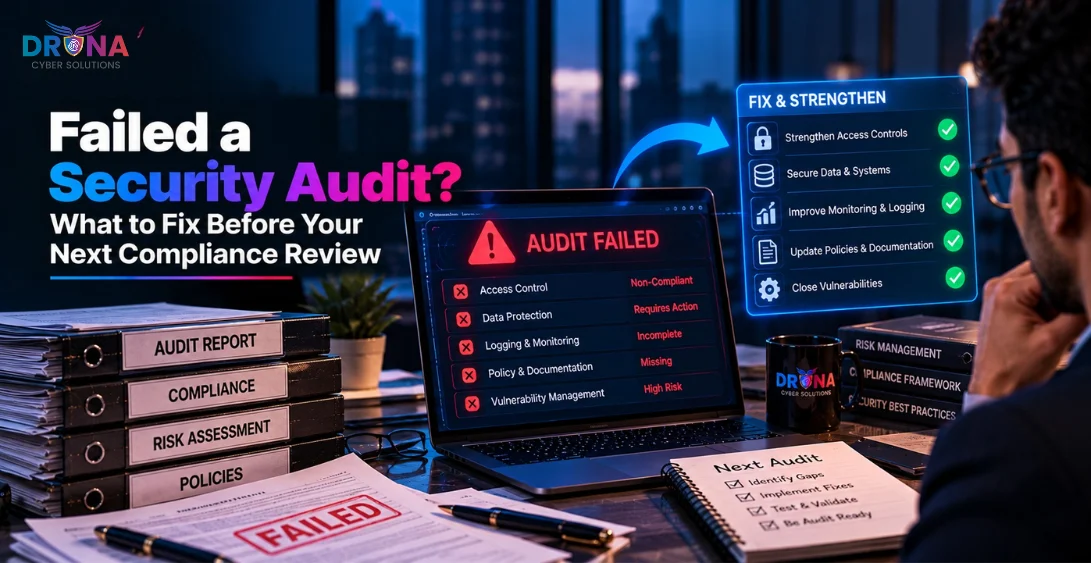
Failing a security audit does not imply that your organization has been the victim of a cyberattack. It means some controls, processes, or documentation did not meet the assessment requirements. Nevertheless, leaving these findings unaddressed may expose the security and create complications in subsequent reviews.
Cybersecurity compliance remediation assists businesses in knowing the reasons behind the failure of controls, rectifying the weak spots, and showing that the improvement efforts are effective. Structured Compliance Audit Services will help organizations move beyond paper responses and prepare meaningful evidence for reassessment.
Failing a security audit does not mean your organization has fallen victim to a cyberattack. It means certain controls, processes, or documentation did not meet the assessment requirements. However, leaving these findings unaddressed can compromise security and complicate subsequent analysis.
Cybersecurity compliance remediation helps businesses understand why controls failed, fix weak spots, and prove improvement efforts are effective. Organized Compliance Audit Services will help organizations move from reacting to paper-based findings to building meaningful, reviewable evidence.
What Does a Failed Security Audit Actually Mean?
An unsuccessful audit means one or more evaluated criteria were not met. Discovered technical vulnerabilities may include inadequate policies, incomplete documentation or records, inadequate access controls, or routines that employees may not always follow.
Some of these findings pose direct security threats. Others relate to documentation or governance loopholes. Minimizing cybersecurity compliance through remediation requires businesses to distinguish issues rather than treating each observation as urgent.
Before starting remediation, organizations should review the original assessment criteria, supporting evidence, and auditor comments. Recognizing the difference between a one-time mistake and a repeated control failure can prevent faulty fixes.
For additional guidance, businesses can explore Cybersecurity Audit Findings: Which Gaps Should Businesses Fix First?.
What Should Businesses Fix Before Their Next Compliance Review?
Successful Cybersecurity compliance remediation involves more than closing tickets. Businesses must determine why each finding occurred, implement appropriate corrective measures, and verify that those measures meet the original requirement.
The following areas deserve particular attention.
1. Unresolved Critical Vulnerabilities
Outdated running systems, exposed services, insecure architectures and lack of security patches can create serious vulnerabilities. Start by identifying exploitable assets, testing their exploitability, and focusing on systems that handle sensitive data or are particularly important.
Document ad hoc protection and a plausible response deadline when real-time patching isn’t possible. Cybersecurity Services can assist with more extensive evaluations concerning technical security weaknesses.
2. Weak Identity and Access Controls
Another reason auditors review employee access is to determine whether they have the appropriate permissions based on their legal rights and to strengthen privileged-account security.
Remediate superfluous access, dormant accounts, shared administrator privileges, and intermittent multi-factor authentication to strengthen compliance with software and hardware cybersecurity.
Periodically review access privileges based on job responsibilities, remove unnecessary permissions, and document approvals. Keep records of regular access reviews, not just before audits.
3. Incomplete Security Monitoring and Logs
Organizations may install security tools without collecting sufficient logs or regularly evaluating suspicious activity. Follow up on records and escalate alerts to those in charge, and decide which systems to log.
Managed SOC services may be valuable for continuous monitoring and investigating alerts where internal capabilities are limited. Businesses should also consider appropriate external exposure through Cyber Threat Intelligence Services, especially where the audit exposes loopholes in threat visibility.
4. Inadequate Data Protection Measures
Data-related findings may include unnecessary data retention, weak encryption, insufficient user controls, and lax third-party access controls.
Effective compliance gap remediation requires securing sensitive information across collection, storage, processing, sharing, and deletion.
The DPDP Act Compliance Checklist helps Indian businesses assess personal-data obligations and identify key preparation areas.
With the risk of compromised credentials or disclosed information, Dark Web Monitoring Services can provide deeper insight into potential data leakage.
5. Untested Incident Response Procedures
An incident response policy is incomplete if employees cannot follow it during an emergency.
Cybersecurity compliance remediation should ensure that incident classification, escalation contacts, containment responsibilities, and communication procedures are clearly written.
Conduct tabletop exercises to test decisions and identify operational gaps. Incident Response Services can support investigation and readiness for response.
If previous incidents remain unexplained, Digital Forensics Services may help establish what happened and preserve relevant evidence.
6. Weak Backup and Recovery Arrangements
Auditors may identify backups that are incomplete, inadequately protected, or never tested.
Review backup coverage, recovery objectives, access restrictions, and restoration procedures. Record test outcomes and investigate failures.
Where malware has damaged systems, Malware Analysis Services can support investigation into malicious activity.
Data Recovery Services may also help assess recovery options when business information becomes inaccessible.
7. Outdated Policies and Employee Practices
Written policies must reflect actual operations. A document stating that access is reviewed quarterly provides little assurance when reviews never occur.
Update procedures, assign accountable owners, and establish measurable review schedules.
Employee behavior matters equally. Corporate Cybersecurity Training can help teams understand security responsibilities and recognize common threats.
For wider organizational guidance, review Cybersecurity Awareness Month 2026: 10 Security Mistakes Indian Businesses Should Stop Making.
How Should Businesses Build a Remediation Action Plan?
A detailed plan turns audit observations into corrective actions. Security, IT, legal, compliance, and business teams should understand their roles in creating remediation to ensure cybersecurity compliance.
Each finding should have:
- A documented root cause: Explain why the control failed, not merely what the auditor observed.
- An accountable owner: Assign responsibility, corrective action, and a realistic completion date.
- Clear closure evidence: Identify the records, test results, or approvals needed to demonstrate improvement.
Prioritize actively exploitable weaknesses, sensitive data exposure, and major control failures. Lower-risk documentation issues can follow an agreed schedule.
Where applicable, cyber audit support can help coordinate evidence collection, control mapping, and reassessment preparation.
How Can You Prove That Audit Findings Have Been Resolved?
Corrective work does not necessarily prove a finding is closed. For example, installing a patch should be followed by an examination to confirm the vulnerable version has disappeared. Real access-review records should help update an access policy.
Independently validate effective cybersecurity compliance remediation where suitable, especially for high-risk findings.
Maintain configuration evidence, vulnerability scan findings, accepted policy, training records, test, and management sign-offs.
Before the next review, take an in-house preparedness test to identify remaining weaknesses. Evidence operating effectiveness, not just the presence of a control.
What Mistakes Should Businesses Avoid During Remediation?
Hasty remediation can create more issues when organizations focus on passing the next audit rather than improving security.
Common errors include closing findings without verification, altering documentation without implementing controls, and failing to address root causes and recurring weaknesses.
Another error is believing that adherence to a single framework meets all regulatory requirements. Businesses should assess requirements based on their industry role, business, contracts, and applicable laws.
The article DPDP Compliance Mistakes That Can Cost You Crores highlights additional considerations for Indian organizations managing personal data compliance.
Conclusion
An unsuccessful security audit is a red flag that your organization needs remedial action before the next conformity review. Unaddressed vulnerabilities, weak access controls, insufficient evidence, and inefficient response procedures can increase operational risk and lead to recurring audit failures.
Drona Cyber Solutions helps companies turn audit outcomes into quantifiable security improvements. Through compliance testing, gap testing, remediation advisory, and technical security services, we help organizations identify vulnerabilities, prioritize remediation, and justify it.
Whether your business needs cybersecurity compliance remediation or practical help preparing for reassessment, the right support can streamline the process and make it more efficient.
Don’t carry unresolved security gaps into your next audit. Contact Drona Cyber Solutions today to review your findings, strengthen critical controls, and prepare for your next compliance assessment with greater confidence.
FAQs
What is cybersecurity compliance remediation?
Cybersecurity compliance remediation is the process of fixing the security and compliance vulnerabilities found during an assessment, validating them, and gathering evidence for use in the review process.
How long does security audit remediation take?
The time schedule will be based on the number and the severity of findings, involved systems, the resources available, and the complexity of corrective measures to follow.
Can a company pass its next audit after failing the previous one?
Yes, potentially. Businesses must fix prior applicable findings, prove the control’s effectiveness, and meet the next assessment’s requirements. Past failure does not doom future success.
Why is compliance gap remediation important?
It helps organizations respond to detected control weaknesses, reduce unnecessary security exposure, enhance accountability, and document improvements for the next assessment period.