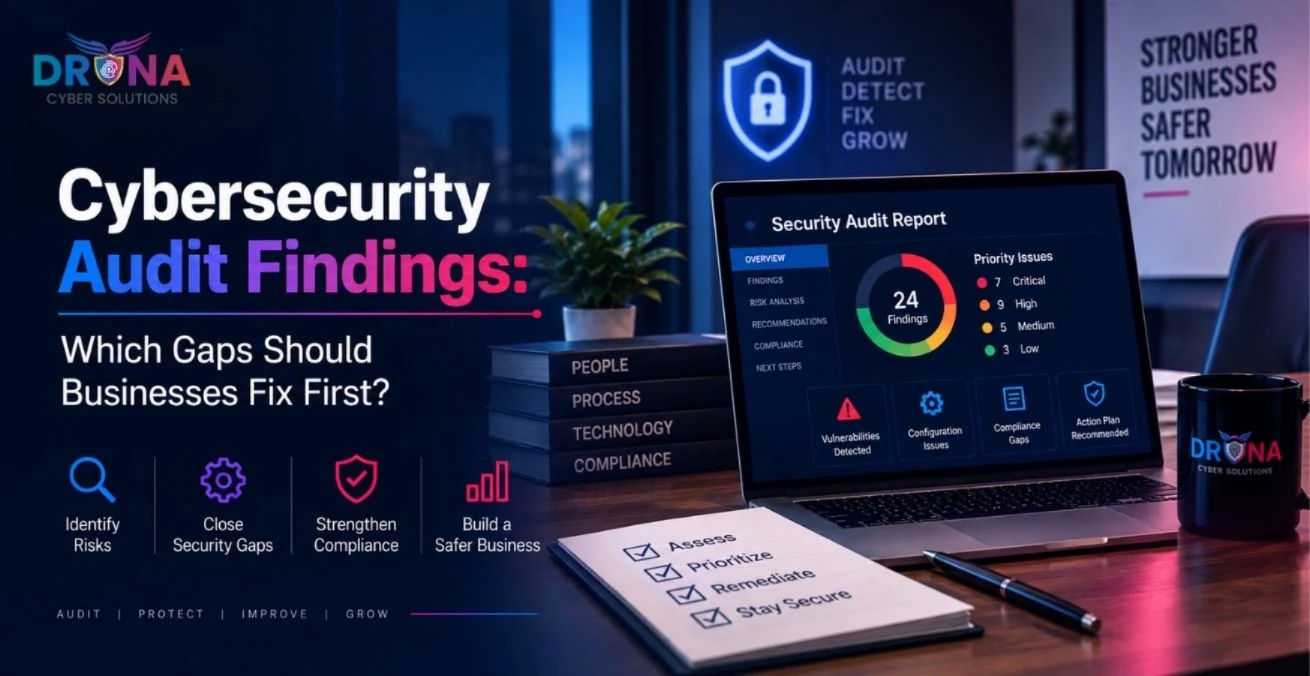
A cybersecurity audit may reveal dozens of vulnerabilities, but not all findings are equally urgent. Companies should understand the difference between issues that can lead to immediate exposure and those that can be addressed through a planned recovery process.
By prioritizing findings based on risk, business impact, exploitability, data exposure, and regulatory relevance, security teams can help to allocate resources where they are most needed.
What Are Cybersecurity Audit Findings?
Cybersecurity audit results are vulnerabilities, control lapses, or non-conformities found during a security audit. They may relate to technical vulnerabilities, access control, security monitoring, data protection and incident response, policies, or third-party security.
A discovery does not necessarily mean an organization has been breached. It means a security or compliance control should be addressed. The importance of the discovery varies based on the system impacted, the risk of exploitation, the possible business consequences, and the ability of other controls to mitigate the risk.
This is the reason why the audit report should not be seen by the businesses as a list of things that must be done as one reads down to the bottom.
Why Should Businesses Prioritise Audit Findings?
Organizations often do not have limitless security budgets, technical resources, or time. Trying to fix all findings at once can make remediation ineffective and may even cause truly critical risks to compete with comparatively minor ones for attention.
An efficient cybersecurity risk assessment helps security teams identify which findings pose the greatest exposure. Prioritization must consider a weakness’s technical severity and the context in which it occurs.
For example, the same vulnerability in an isolated system inside a company might be handled differently than a vulnerability in an internet-facing application that handles sensitive customer data.
Which Cybersecurity Audit Findings Should Be Fixed First?
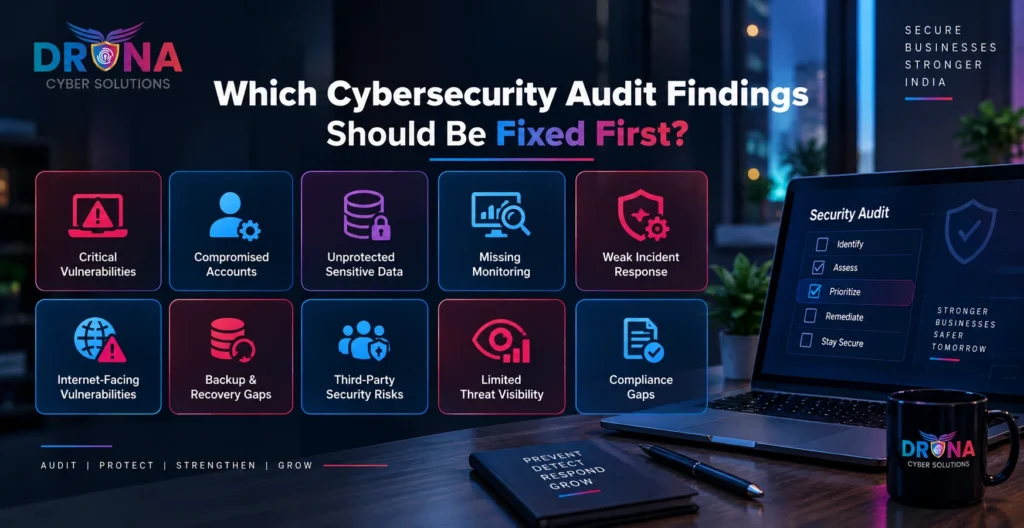
1. Actively Exploitable Critical Vulnerabilities
Prioritize actively exploitable, critical vulnerabilities as soon as possible, especially when they affect internet-facing systems or other vital business infrastructure.
The security team should identify whether the organizational environment is exposed to exploitation, whether the targeted asset is exposed, and whether effective mitigations or patches exist.
In cases where short-term correction cannot be done, organisations ought to look at temporary solutions like limiting exposure, disabling vulnerable functionality, or implementing suitable compensating controls while a temporary solution is constructed.
2. Compromised or Excessively Privileged Accounts
A compromised account with too many privileges can give an attacker far more access than a standard compromised account.
Pay close attention to audit findings of dormant or inactive administrator accounts, excessive permissions, shared privileged credentials, or former employees with access. Organizations should review access to determine whether it is needed and eliminate unnecessary access.
Organizations can mitigate the risk of account compromise by using multi-factor authentication, privileged access controls, strong credential controls, and frequent access reviews.
3. Unprotected Sensitive or Regulated Data
Results containing sensitive business or personal data may pose both compliance and security risks.
Businesses should identify what information is revealed, where it is stored, who can access it, and whether appropriate security controls protect it. The risk can be even greater when confidential data is available on openly exposed systems or through unnecessary user privileges.
The response to these findings might involve adjustment of access controls, encryption, data storage, data retention practices, monitoring, and third-party access.
4. Missing Security Monitoring and Logging
This security control gap is more worrying when it denies an organization the opportunity to notice suspicious activity.
Without proper security logs from critical systems or monitoring of key events, attackers can operate undetected. This may also complicate post-incident investigations.
Managed SOC Services may help businesses build continuous monitoring, alert investigation, and escalation practices in environments where internal security teams cannot provide consistent coverage.
5. Weak Incident Response Capabilities
An audit finding related to incident response should be examined carefully because the organization may need these capabilities when time is critical.
Businesses should confirm that the incident-response plan is up to date, that responsibilities are clearly assigned, and that escalation and communication processes have been tested.
A documented but unimplemented plan may not be effective in a real attack. Organizations should run the right tabletop exercises or simulations and revise the process based on the weaknesses identified.
Incident Response Services may offer specialized incident investigation, containment, coordination, and recovery when an incident happens.
6. Unresolved Vulnerabilities on Internet-Facing Assets
Not all vulnerabilities have the same exposure. A vulnerability in an externally accessible application, VPN, web server, API, or other internet-facing asset can give attackers a direct entry point.
When remediating, businesses should determine whether the affected system is publicly accessible and whether exploitation has been observed or attempted.
Exposure may be temporarily minimized while the inherent vulnerability is addressed. The goal is to minimize the attack surface while ensuring required business functionality.
7. Backup and Recovery Failures
A discovery that backups are not complete, unavailable, unverified or susceptible to the same attack on production systems can be dire in business terms.
Firms cannot just ensure that they have backups. They should test their ability to restore critical information and verify recovery procedures against the organization’s operational requirements.
This is especially significant for ransomware resilience, where attackers may target recovery resources as part of an attack.
Ransomware response services can supplement technical recovery planning and help the business prepare for encrypted, stolen, extorted, or disrupted operations.
8. Weak Third-Party Security Controls
A company might have strong internal controls but still face high risk from its vendors and service providers.
Audit results on third-party access, poor vendor assessment, weak security requirements in a contract, or the absence of incident-notification procedures must be considered based on the supplier’s significance.
A supplier with access to critical infrastructure or sensitive data may need much closer monitoring than a supplier with limited access. Companies must categorize third parties by risk and apply the right security standards.
9. Gaps in Threat Visibility
Conventional security controls might not give insight into all threats to an organization. These external exposures, weakened credentials, rogue infrastructure, and new threats may emerge beyond the corporate network.
Cyber Threat Intelligence Services can assist organisations to learn about pertinent threat activity and detect external indicators that might need investigation or defensive action.
Similarly, Dark Web Monitoring Services can provide further insight into company credentials and data exposed in underground sources.
These features may be used alongside other internal security measures, not to substitute them.
10. Compliance and Documentation Gaps
Compliance findings are not always direct technical vulnerabilities, but consistent documentation or control gaps cannot be overlooked.
Businesses need to decide whether the finding indicates missing documentation, an improperly implemented control, or a deeper process weakness. A policy not based on real business practice can create difficulties in future audits.
Compliance Audit Services may assist organizations to review relevant requirements, detect security compliance gaps, map the findings to controls, and create structured remediation plans.
How Should Businesses Classify Audit Findings?
A remediation program must be practical and consider more than the audit report’s severity label.
Findings can be assessed by businesses based on:
- Potential business impact
- Likelihood of exploitation
- Internet exposure
- Sensitivity of affected data
- Privileged access involved
- Regulatory or contractual implications
- Availability of compensating controls
- Evidence of active exploitation
This method helps security teams make better remediation choices without assuming all high or medium findings carry the same real-world risk.
Conclusion
Many findings may be included in a cybersecurity audit report, but remediation must start with the gaps that combine the highest security exposure, business impact, and compliance risk.
Critical vulnerabilities, compromised accounts, exposed sensitive data, monitoring weaknesses, incident-response gaps, and insecure recovery capabilities often receive more attention than less impactful administrative concerns.
The trick is to turn audit results into a coherent remediation program instead of treating them as a fixed checklist.
Drona Cyber Solutions offers cybersecurity audit services that help businesses evaluate their security posture, understand audit results, close compliance gaps, and strengthen the controls most relevant to their environment.