A business should not start researching a ransomware negotiation company in India once its systems are encrypted. In a ransomware incident, every decision can affect downtime, data exposure, recovery, and communication with attackers.
A capable ransomware negotiation company in India should therefore offer more than communication with threat actors; it should work alongside investigation, response, intelligence, and recovery teams.
Why Ransomware Negotiation Requires More Than a Negotiator
A ransomware attack rarely involves only encrypted files. Hackers can steal sensitive data, compromise administrator accounts, move across systems, and threaten to publish it. This means a cyber extortion response must address the broader incident, not treat the ransom demand as a single issue.
Before an emergency, companies should consider whether a ransomware negotiation company in India they hire can facilitate negotiation with technical teams, preserve evidence, analyse the attacker’s claims, and support recovery decisions.
7 Capabilities to Check in a Ransomware Negotiation Provider
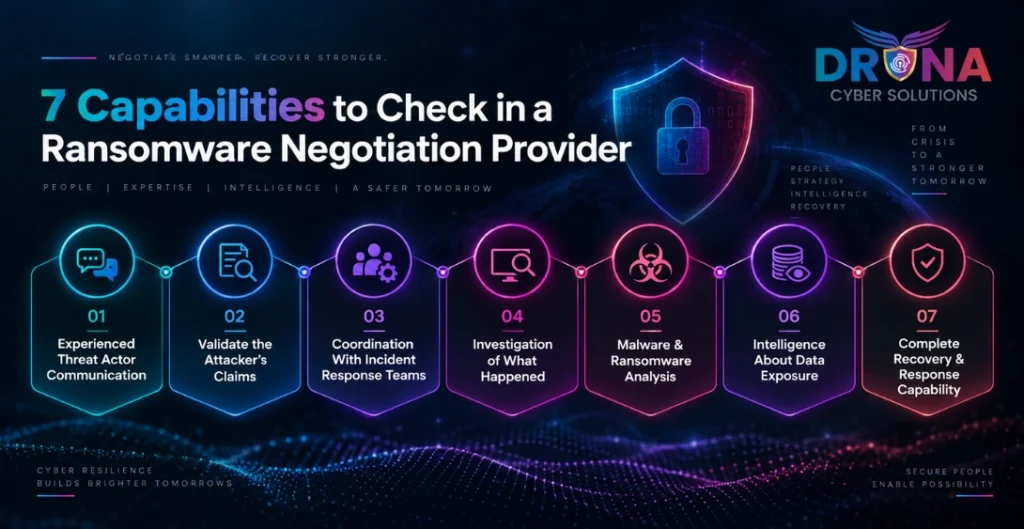
Here are some of the top capabilities to check while choosing a ransomware negotiation company in India:
1. Experienced Threat Actor Communication
The first is organised communication with ransomware operators. A professional ransomware negotiation company in India must be familiar with the handling of ransom demands, timeframes, proof-of-compromise assertions, sample decryptions, and data-leak threats.
Avoid unnecessary revelations about the victim’s business, financial standing, ability to recover, or internal security climate during negotiation. The goal is to create controlled communication while the incident response process continues.
2. Ability to Validate the Attacker’s Claims
Not all attacker claims must be accepted. A ransomware group may claim it has stolen large amounts of data or gained access to critical systems.
Cyber Threat Intelligence Services can be helpful here. Threat intelligence can identify the group, known behaviours, infrastructure, past campaigns, and publicly visible activity.
Validation matters because business leaders need to understand what they are really handling before making major decisions.
3. Coordination With Incident Response Teams
Negotiation cannot be done independently when systems are actively compromised. A business might need to isolate infected machines, identify the point of entry, gain privileged access, and determine whether attackers still have access.
Professional Incident Response Services may collaborate with negotiation to handle the incident’s technical aspects. This division of duties enables the negotiation process to go on as security teams can concentrate on the containment and recovery.
4. Investigation of What Happened
A ransomware demand is not the end of the story. Businesses also need to know how attackers accessed the environment, which systems they accessed, what information may have been stolen, and how long the activity lasted.
Digital Forensics Services may help analyse relevant systems, devices, logs, accounts, and other available evidence. This research will provide valuable background information when evaluating attacker claims and the true extent of an incident.
5. Malware and Ransomware Analysis
The response strategy may also depend on understanding the ransomware itself. Ransomware families may show varying encryption behaviour, deployment methods, and known characteristics.
Specialised malware analysis services may analyse suspicious files, payloads, scripts, or other malicious components related to an incident. This would assist security teams to appreciate the technicality of the attack rather than wholly depending on the information provided by the attackers.
6. Intelligence About Data Exposure
Contemporary ransomware is often characterised by data theft and extortion as well as encryption. Attackers may threaten to post information on leak websites or claim that stolen data is already available.
Dark Web Monitoring Services help companies identify relevant exposure in criminal forums, leak websites, and other monitored areas. This is especially critical when attackers exploit the threat of public disclosure during negotiations.
7. A Complete Recovery and Response Capability
Lastly, companies must not select a provider that only negotiates. A severe ransomware attack can involve containment, investigation, malware analysis, intelligence, recovery coordination, and monitoring.
Ransomware Response Services unites these activities so negotiation fits into a broader response plan. This is especially crucial when the company is experiencing operational disruption and possible data exposure.
What Should Businesses Ask Before Hiring a Ransomware Negotiation Company in India?
Decision-makers must ask practical questions before hiring a ransomware negotiation company in India:
- Does the provider have experience communicating with ransomware groups?
- Can it liaise with technical response teams during negotiations?
- How are attacker claims validated?
- Can the provider inquire about possible data theft?
- Does it access pertinent threat intelligence?
- Does it support incidents of inter-system occurrence?
- What will be the outcome of the negotiation when the business remains threatened by security problems?
The responses may indicate whether the provider offers limited negotiation support or comprehensive ransomware negotiation support.
Why Preparation Matters Before a Ransomware Demand
Delaying system encryption will cause undue strain. Contact information, escalation, legal, backup information, decision-making, and incident-response duties are best determined in advance.
Businesses must also know that not all negotiations are guaranteed to yield a certain result. Attackers may offer a decryption tool or even claim they deleted stolen information, but organisations must investigate the compromise and harden affected systems.
For organisations seeking more comprehensive Cyber Security Services, ransomware negotiation should be viewed as part of a broader security and incident-response program.
How Drona Cyber Solutions Supports Ransomware Incidents
Drona Cyber Solutions is the best cyber security company in India and views ransomware not as a ransom-demand issue but as a broader cyber incident. Its response capability can combine ransomware negotiation, threat intelligence, investigation, malware analysis, dark web monitoring, and incident response based on the incident’s demands.
Our team of cybersecurity experts centres on helping organisations analyse the situation, manage controlled communication, investigate the compromise, and make responsible response decisions.
For companies in need of Cyber Security Services in Ahmedabad or support across India, having an established response partner before an incident can help organise the process when a ransomware attack happens.
Conclusion
A ransomware attack can easily trigger a business, financial, legal, and reputational crisis. This is why the decision to negotiate with ransomware companies in India should not be based solely on the ability to communicate with the attackers. The provider must link negotiation to threat intelligence, incident response, digital forensics, malware analysis, dark web monitoring, and recovery support.
Drona Cyber Solutions is the best ransomware negotiation company in India and brings these capabilities together to deliver a unified response to ransomware attacks. Once the threat is understood and the compromise is investigated, the focus remains on helping businesses respond with more control and information.
If your organisation needs ransomware negotiation support backed by extensive cybersecurity experience, Drona Cyber Solutions can help you prepare for and respond to ransomware attacks in India. Report an incident today, and our team of cybersecurity experts will connect with you to understand your situation and take possible action.
FAQs
What does a ransomware negotiation company do?
A ransomware negotiation company liaises with attackers on behalf of an impacted organisation, manages negotiation-related information, and helps coordinate the process with the broader incident response.
Are ransomware negotiation and ransomware recovery similar concepts?
No. Negotiation focuses on communication and ransom-related discussions, while recovery focuses on restoring systems, eliminating attacker access, investigating the incident, and returning the environment to a secure operating state.
Should companies wait until they are attacked to identify a ransomware negotiation service?
No. Companies can minimise delays by identifying a provider and establishing an escalation process before an incident.
Will negotiation ensure that stolen information is not published?
No. Organisations must be wary of attacker promises and proceed to investigation, containment, monitoring, and relevant legal or regulatory procedures, as well as negotiation.
What additional value should a ransomware negotiation provider provide beyond negotiation?
Ideally, the provider should be able to negotiate with Incident Response Services, Digital Forensics Services, Cyber Threat Intelligence Services, malware analysis, dark web monitoring, and ransomware response.