
Many companies believe DPDP compliance begins by changing the privacy policy and putting up a consent banner. That is exactly where many compliance problems start.
The Digital Personal Data Protection Act, 2023, puts clear duties on companies that gather, hold, or handle personal data. This covers customer details, staff files, money-related records, and online tracking information. Compliance goes well beyond just writing policies. It reaches into the actual ways data is gathered, kept safe, stored over time, and handled when something goes wrong.
The money at stake is high. Under the Act, some mistakes, such as poor protection measures or slow action on breach duties, can result in fines of up to ₹250 crore depending on the seriousness of the breach.
Most fines do not result from companies deliberately trying to break the rules. They come from simple mistakes in daily operations that could have been fixed.
Common DPDP Compliance Mistakes Businesses Must Avoid
Most compliance issues arise because companies do not fully understand their day-to-day duties under the Act. The real danger is not that people have never heard of the rules. It is because they fail to carry them out properly.
Improper Consent Collection
Consent forms one of the basic needs under DPDP. It has to be clear about the exact use, given with full knowledge, given freely, and shown without doubt. Many companies still gather wide or combined consent without spelling out the reason.
This leads straight to a compliance issue because faulty consent removes the proper legal ground for handling the data. Companies also need to keep records of every consent to stay accountable in their operations. Without solid consent records, it gets hard to show that the company followed the rules.
Collecting More Personal Data Than Necessary
DPDP works on the idea of purpose limitation. Companies should gather only the personal data they need for a clear and legal reason. Many groups pull in extra details in case it helps later, even when there is no real business need right now.
This raises the overall risk level. Extra personal data increases the risk of loss in a breach and adds more day-to-day compliance work.
Weak Security Safeguards
This counts as one of the costliest compliance mistakes in monetary terms.
The Act requires companies to implement suitable security measures to protect personal data. Loose login rules, bad password habits, missing encryption, and old systems all make it easier for data to get stolen.
Mistakes here can incur the most severe penalties under DPDP. That is why strong cybersecurity measures play a direct role in meeting compliance requirements.
Drona Cyber Solutions works with companies to improve their security setups through ongoing checks, incident preparation, and detailed security reviews that reduce compliance risks.
Delayed Data Breach Reporting
Many companies hold off on raising the issue within the team after a breach, preferring to look into it first. This step creates extra risk.
Under DPDP, companies must follow the reporting rules for breaches once personal data is exposed. Slow reactions can lead to trouble with regulators. Quick action counts. Companies need clear internal steps for identifying problems, moving them up the chain, and preparing reports.
This is the point where having a solid incident response plan makes a real difference in operations.
Poor Third-Party Data Processor Oversight
Many companies rely on external partners for customer management tools, payment processing, data analysis, or cloud storage. Yet if those partners lose control of personal data, the main company in charge can still be held responsible.
Checks on these partners often get left out. Companies need to examine how outside processors handle protection, data storage periods, and who can access the information. Risk from third parties counts as part of the overall compliance risk.
No Data Retention Controls
Many companies hold on to personal data forever. This step brings avoidable compliance problems.
Once the reason for collecting the data ends, keeping it without a current business need raises both the risk of damage from a breach and the risk of regulatory trouble. Retention rules need to be set out plainly. Practices for removing data must remain consistent over time.
Weak Incident Investigation Processes
A breach that never gets properly investigated leaves gaps in how compliance is handled. Companies have to figure out exactly what took place, which data was touched, and how someone gained access. Without that review, the reports sent out lack accuracy, and the fixes put in place stay weak.
Drona Cyber Solutions assists companies with digital forensic checks, identifying the root cause, and supports incident response, helping businesses create better accountability after breaches.
Business Impact of DPDP Compliance Failures
DPDP failures bring more than just trouble with regulators. They hit daily work, the confidence customers have, and whether the business can keep running smoothly.
Financial Penalties Can Be Severe
Penalties under the Act can run into crores depending on how serious the mistake was and which rule was broken. For companies that handle large amounts of personal data, even a single weak spot in operations can be very costly.
Regulatory Investigations Increase Operational Burden
Compliance mistakes usually set off internal checks, audits, and questions from regulators outside the company. This uses up hours, staff time, and leaders’ attention.
Customer Trust Declines Quickly
Customers hand over their personal data because they believe the company will handle it right. A compliance mistake or breach damages that belief right away. Getting the trust back takes much longer than keeping it safe from the start.
How Businesses Can Reduce DPDP Compliance Risks
Compliance gets better when daily operations follow a clear setup.
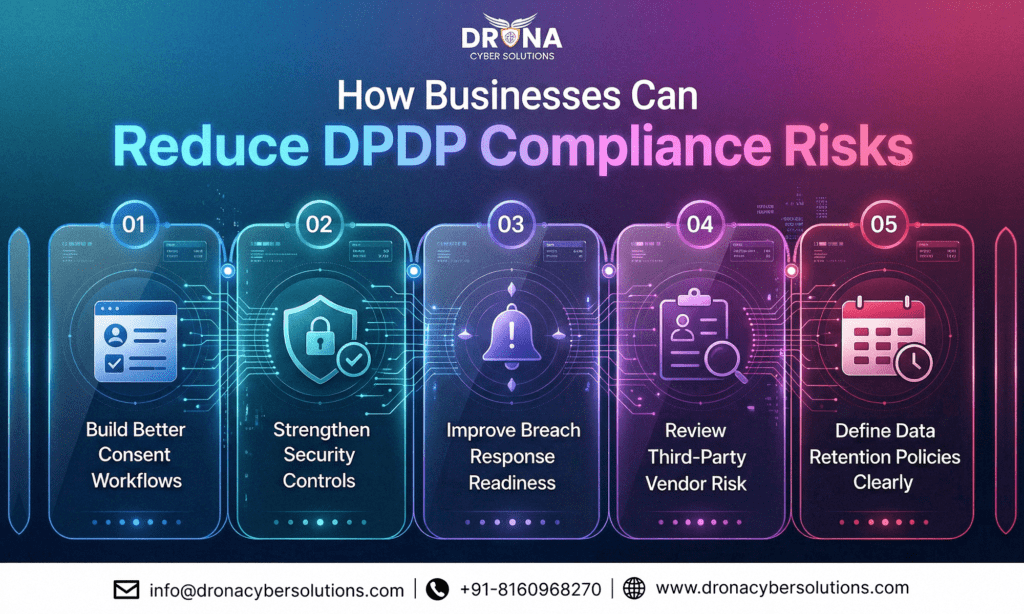
Build Better Consent Workflows
Consent collection needs to remain obvious, tied to a single purpose, and recorded in a way that stands up. Every time a user gives or sees consent, the company should be able to check the full record.
Strengthen Security Controls
Login rules, data encryption, constant monitoring, and frequent security checks reduce both breach risk and compliance issues.
Security now forms a working piece of how compliance gets done. Drona Cyber Solutions helps companies raise their security level through threat monitoring, breach preparation, and forensic support.
Improve Breach Response Readiness
Companies should set up internal processes for identifying breaches, moving them forward, analyzing them, and issuing reports. How fast the response happens shapes the final compliance results.
Review Third-Party Vendor Risk
Every outside company that touches data should be checked for its security level and compliance with standards. Managing vendor risk helps prevent compliance issues that come through others.
Define Data Retention Policies Clearly
Data should be removed once the business reason for keeping it disappears. Plain rules on how long to retain data and when to delete it significantly lower the risk.
Conclusion
DPDP compliance no longer remains only within the legal department or in written policies. It now belongs inside regular business operations.
The largest compliance mistakes usually stem from ordinary gaps in how work gets done—poor protection measures, weak methods for handling breaches, unclear consent procedures, data kept without limits, and no real ability to investigate.
These problems can be stopped before they start.
Drona Cyber Solutions helps companies lower these risks by building stronger cybersecurity operations, raising incident readiness, and providing support during digital forensic investigations. Our experience helps organizations gain tighter control over personal data in daily work and prepare for any compliance issues that may arise.
In a setting where one mistake can cost crores, compliance is no longer something you can choose to skip.