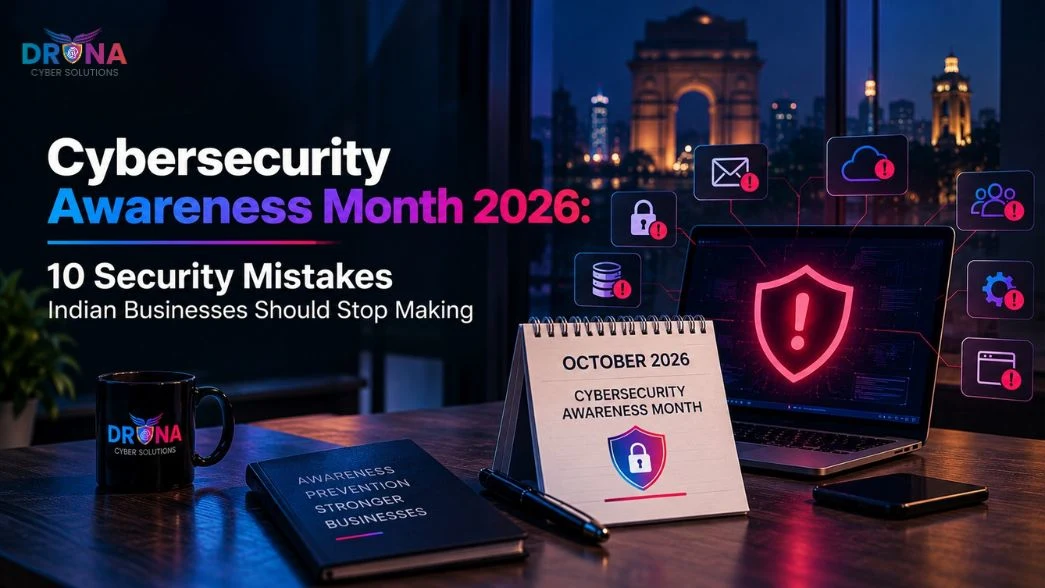
October is Cybersecurity Awareness Month, making it a good time for Indian businesses to assess whether their security practices can withstand real-world cyber threats.
Even with security tools in place, weak passwords, slow patch management, untested backups, and ineffective incident reporting can still put businesses at risk. Reliable Cyber Security Services not only prevent attacks but also help organisations enhance detection, monitoring, and response.
This review matters because of the issue’s scale. The Government of India reported that CERT-In monitored 2,944,248 cybersecurity incidents in 2025 and 2,041,360 in 2024. These figures reflect incidents tracked but do not necessarily imply violations by individual businesses.
This article covers 10 security mistakes Indian businesses should stop making in 2026, including gaps that better Managed SOC Services, Incident Response Services, and Cyber Threat Intelligence Services can address.
10 Security Mistakes Indian Businesses Should Stop Making
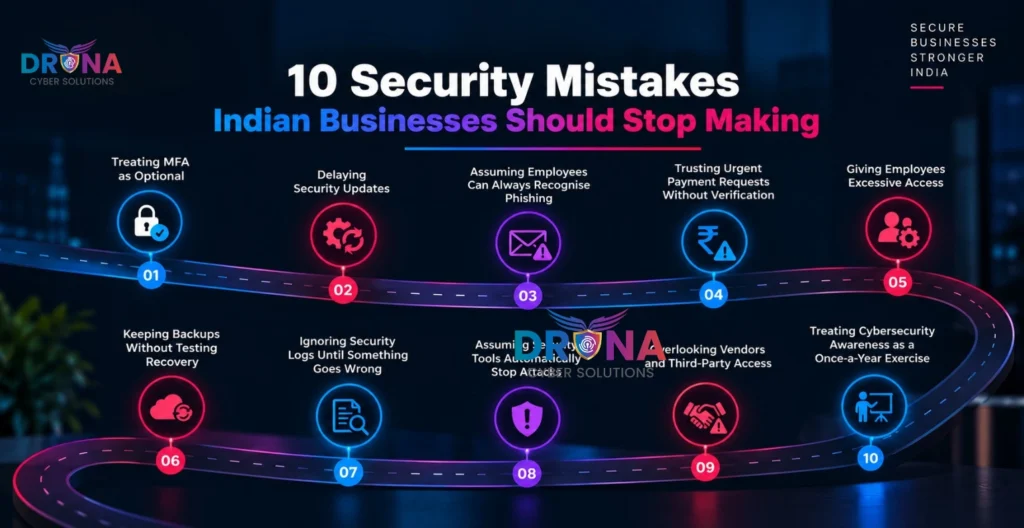
Indian businesses can implement security tools yet remain vulnerable because of unaddressed vulnerabilities or ineffective internal processes and response times. The 10 mistakes below outline some of the most common security oversights organisations should address during 2026 Cybersecurity Awareness Month, along with measurable measures they can implement to reduce risk and strengthen their overall cybersecurity posture.
1. Treating Multi-Factor Authentication as Optional
A password may not be enough to secure an account if attackers steal credentials, use them through phishing, or expose them during a breach. Pay special attention to remote access, administrator accounts, cloud consoles, and business email accounts.
What businesses can do: Use multi-factor authentication (MFA) for critical accounts and, where possible, adopt phishing-resistant authentication for privileged users. Access exceptions and eliminate redundant access.
2. Delaying Security Updates
No patches are applied to the operating systems, applications, browsers, and internet-facing systems, leaving known vulnerabilities open to attackers. The issue is harder to manage when companies fail to keep an accurate record of their technology.
What businesses must do: Track critical assets, prioritise patches by severity and exposure, and ensure they’re installed. When the immediate replacement cannot be done, then replace unsupported software or isolate.
3. Assuming Employees Can Always Recognise Phishing
Phishing can impersonate suppliers, executives, cloud providers, and internal departments. AI-generated content can also make fraudulent messages more realistic.
What businesses should do: Train employees to verify unusual requests, be suspicious of links, and report anything unusual. For sensitive requests, verify them through a trusted communication channel.
4. Trusting Urgent Payment Requests Without Verification
Business email scams may include hacked accounts or impersonation of executives and suppliers. A message requesting you to make an urgent transfer or change of bank account might seem genuine.
The FBI’s Internet Crime Complaint Centre recommends verifying account-information changes through a secondary channel.
What companies must do: Authenticate payment changes using previously verified contact information. Whenever feasible, initiate payment separately from approval, and add an additional mechanism for high-value transfer checks.
5. Giving Employees Excessive Access
Employees can have permissions that they do not require and shared accounts and unnecessary administrator privileges may complicate investigations.
What businesses ought to do: Use minimum-privilege access, require individual accounts, review administrator privileges, and revoke privileges when employees quit or change jobs. Check service accounts and other non-human identities.
6. Keeping Backups Without Testing Recovery
Backups alone aren’t enough to rebuild after a ransomware attack or system crash. Copies can be obsolete, incomplete, unavailable, or affected by the same event as production systems.
What businesses must do: Keep backups secure, maintain an offline or sufficiently isolated copy, and regularly test restores. If data is damaged or inaccessible, Data Recovery Services can help evaluate possible recovery options.
7. Ignoring Security Logs Until Something Goes Wrong
Authentication logs, endpoint logs, cloud activity logs, and network logs can help investigators reconstruct suspicious activity. The loss or poor retention of logs may complicate the identification of the steps taken by an attacker after breaking into a system.
Direction 28 April 2022 by CERT-In mandates covered entities to keep ICT system records safely during a 180-day rolling period within India’s jurisdiction. The Directions also mandate covered entities to disclose cyber incidents within six hours. Organisations should confirm their obligations.
What businesses should do: Ensure critical systems log events, meet retention requirements, and alert responsible personnel. Have a defined escalation procedure for suspected cases.
8. Assuming Security Tools Automatically Stop Attacks
Firewalls, endpoint defence, email filters, and cloud security controls are all important, yet buying these tools does not ensure alerts are reviewed and mitigated.
What businesses ought to do: Check whether security notices reach the right people and whether high-priority events are addressed promptly, even after hours. Managed SOC services can provide additional monitoring and investigation for businesses that lack the resources to do this in-house.
9. Overlooking Vendors and Third-Party Access
The contractors, software suppliers and suppliers may have access to the company’s systems or sensitive information. Customers and partners of an organisation can be exposed to risk due to weak security at a connected organisation.
What companies may do: Maintain a list of third-party relationships, restrict access to what each vendor requires, periodically review authorisations, and establish security and incident-reporting requirements in contracts.
10. Treating Cybersecurity Awareness as a Once-a-Year Exercise
A single training session in October won’t compensate for weak security measures or untested response plans. Employees may know the risk of phishing but may not be able to act on the spot.
What companies should do: Provide regular awareness materials and exercises on phishing, suspicious payments, hacked accounts, information management, and reporting such cases. Apply the results to enhance response procedures and policies.
How Should Businesses Use Cybersecurity Awareness Month 2026?
October is not a reminder campaign; it should be a checkpoint for quantifiable improvements.
Businesses can start by reviewing MFA, overdue patches, backup restoration, privileged access, and security log retention. They can also test employees’ knowledge of how to report suspicious activity and whether the organisation can probe and contain an incident.
Incident Response Services can help organisations investigate and respond to cyber incidents. The most effective approach is to identify the biggest gaps, assign someone to fix them, and ensure the changes work.
Conclusion
Cybersecurity errors do not occur in a vacuum. Password theft can be even more harmful when authentication mechanisms are weak, too many permissions are granted, and the theft goes unnoticed. Similarly, ransomware can cause greater disruption if no backup tests have been conducted.
Cybersecurity Awareness Month 2026 is the year to turn awareness into action. Drona Cyber Solutions helps companies strengthen their security posture by monitoring, investigating, and responding to cyber incidents, and by meeting other cybersecurity requirements. Its Cyber Threat Intelligence Service also helps organisations identify relevant external threats and signs that require investigation.
Preventable security holes should not be your next business backbreaker. Contact Drona Cyber Solutions to assess your cybersecurity priorities, address critical vulnerabilities, and build a stronger response to new cyber threats.
FAQs
When is Cybersecurity Awareness Month 2026?
October is Cybersecurity Awareness Month 2026. It helps businesses to audit security practices, train employees, and assess incident preparedness.
What cybersecurity errors should businesses fix?
Start with weak authentication, infrequent security patches, excessive permissions, untested backups, inefficient monitoring, and unclear incident-reporting steps.
What can Indian businesses do to enhance cybersecurity awareness?
Regular employee training, real-world exercises, access reviews, patching, backup testing, and incident-response drills.
Is it mandatory to report all cyber incidents to CERT-In within six hours?
CERT-In’s Directions require reporting covered cyber incidents within six hours. Companies must refer to the official Directions and other relevant guidance to understand their duties.