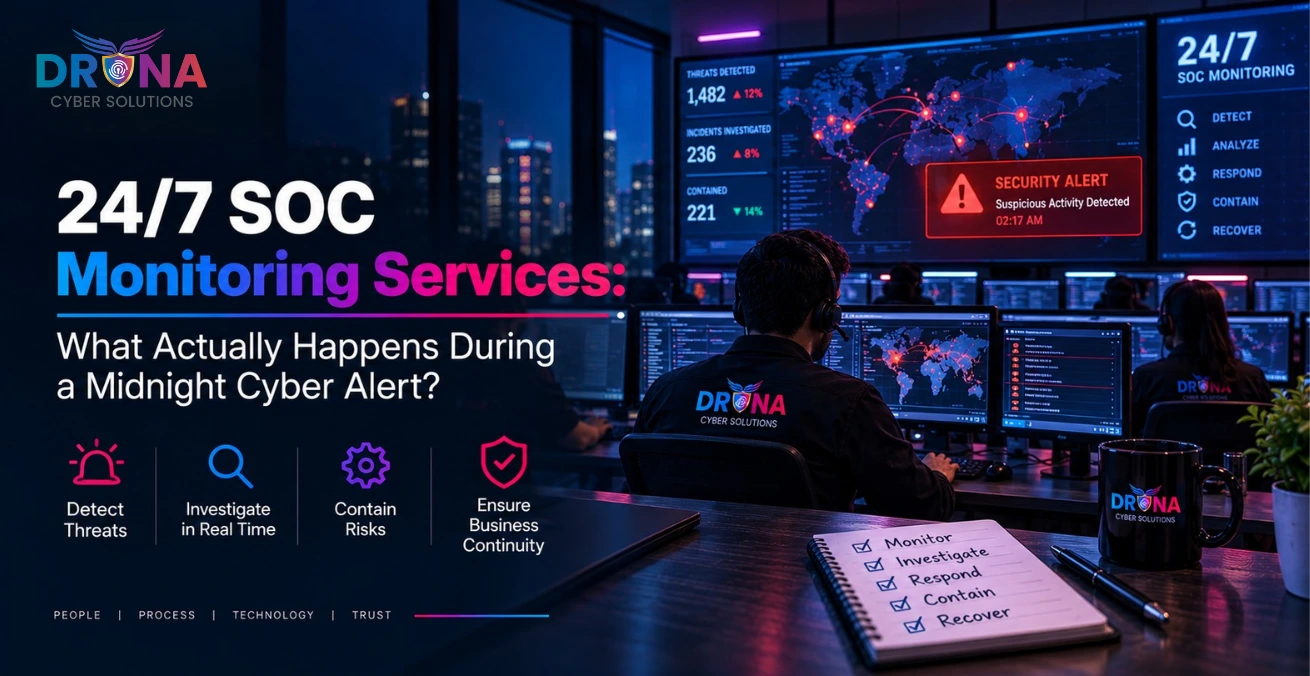
24/7 SOC monitoring services provide businesses with 100% security coverage, even when their own IT and security departments are offline. The appearance of suspicious logins, malware notifications, uncommon network connections, or ransomware at midnight should not merely wait until the morning.
The Security Operations Centre (SOC) constantly tracks security events, validates suspicious activity, investigates potential threats, and prioritises incidents by severity.
So what happens when an alert hits the SOC in the middle of the night? Keep reading to explore how 24/7 SOC monitoring services assist.
Why Do Cyber Alerts After Office Hours Matter?
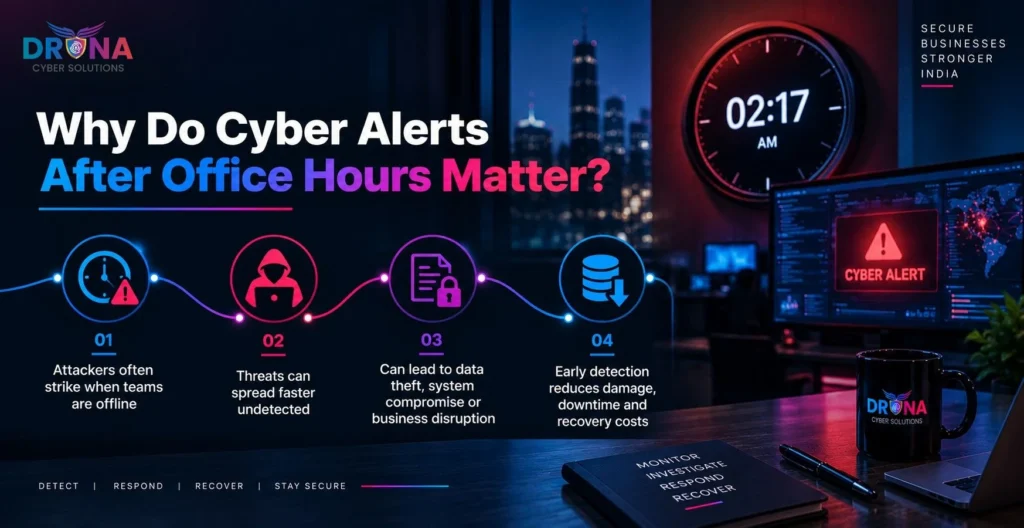
Hacking is not confined to working hours. Attackers may try to steal accounts, install malware, move between systems, or access sensitive information at any time.
That is why 24/7 SOC monitoring services matter for businesses that can’t afford to leave security signals unattended at night. The incident at 1:00 AM can be as innocuous as it is suspicious, or it can be the first sign of a bigger attack.
With 24×7 security surveillance, the goal is not to treat every alert as an emergency. The goal is to determine which events need investigation and handle meaningful alerts at the appropriate time.
What Happens When a SOC Receives a Midnight Alert?
When the SOC receives an alert, analysts first determine what caused the alarm and whether the activity looks suspicious.
50 failures at a time could be normal. A series of failed attempts, followed by a successful login from an unusual location, may require immediate investigation, especially when the account has access to critical systems.
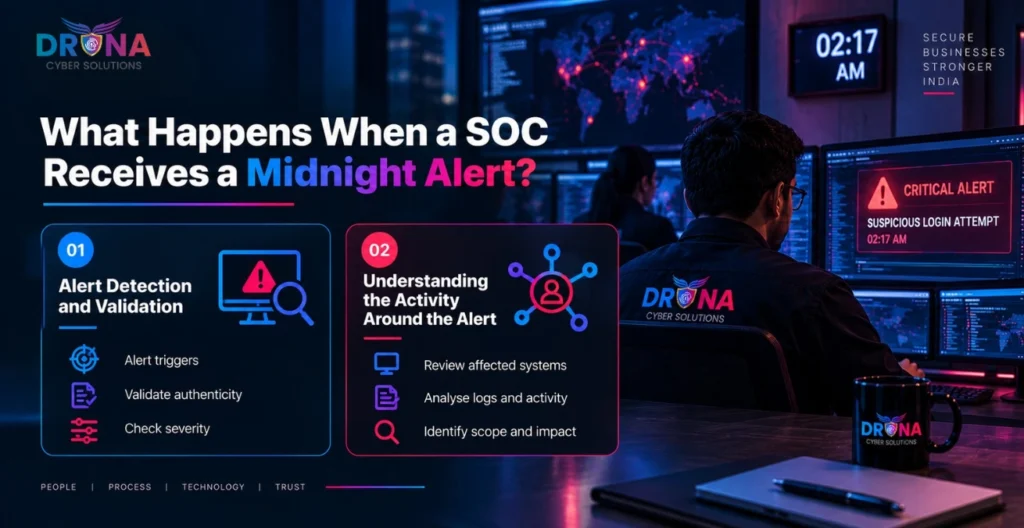
Alert Detection and Validation
SOC analyst examines data such as the affected user, endpoint, application, source location, time of activity, and adjacent security events. This helps determine whether the event is normal behaviour, a configuration issue, suspicious activity, or a possible security incident.
Understanding the Activity Around the Alert
Mature SOC investigations don’t examine an event in isolation. Analysts can match activity across identities, endpoints, networks, cloud environments, and applications to determine whether the alert is part of a larger attack.
How Does a SOC Decide Whether an Alert Is Serious?
Not every security alert requires the same response. The SOC evaluates the potential impact before deciding whether to escalate an event.
Factors can include:
- Whether a privileged account is involved
- Whether a critical system is affected
- Whether malicious activity is continuing
- Whether lateral movement is suspected
What Happens When a Midnight Alert Becomes a Security Incident?
Once 24/7 SOC monitoring services confirm malicious activity, it shifts from alert handling to incident investigation and escalation.
The team might investigate compromised endpoints, accounts, network traffic, cloud configurations and other security information. This helps determine whether the event is a single incident or part of a broader compromise.
From Detection to Escalation
The SOC can advise or take action based on the organisation’s response procedures; these may include isolating an endpoint, restricting a compromised account, blacklisting malicious infrastructure, or escalating an incident to management, as the organisation decides.
When further research and isolation are needed, Incident Response Services will assist the organisation with next steps.
What Happens If Malware Is Detected at Midnight?
A malware alert may be as simple as an obstructed suspicious file or a sign of a broader breach. The 24/7 SOC monitoring services team can identify the affected endpoint, analyse the file or process, and scan related indicators on monitored systems.
When more technical research is needed, Malware Analysis Services can help you understand the behaviour of suspicious software, what systems it might impact, and what indicators to research in other areas.
It does not allow a team to remove a malicious file without knowing whether related activity exists elsewhere in the environment.
What If the Midnight Alert Involves Ransomware?
You may need to escalate ransomware activity quickly because an attacker can encrypt systems, steal information, disable security measures, or disrupt business operations.
Signalling that something might be amiss: file anomalies, suspicious executable activity, mass encryption, or unusual administrative actions may need immediate investigation.
A SOC can detect and report this activity, and Ransomware Response Services can provide specialised support when the incident becomes a larger-scale ransomware event.
What Happens When Employee Credentials Are Compromised?
A compromised employee account at midnight can be hard to prove, as the employee may be away and therefore unable to validate the activity.
The 24/7 SOC monitoring services team can scrutinise authentication mechanisms, access patterns, locations, devices, and related activity to determine whether the account was mishandled.
If company credentials may have been disclosed outside the corporate environment, Dark Web Monitoring Services can identify additional indicators of the types of compromised credentials and business information available on underground sources.
The organisation may then need to reassign credentials, end sessions, modify access, or audit other systems linked to the account.
Where Does Threat Intelligence Fit Into Midnight Monitoring?
Security alerts become more useful when analysts have external context about the indicators they are investigating.
Cyber Threat Intelligence Services can provide information about malicious IP addresses, domains, infrastructure, threat actors, and other indicators associated with known cyber threats.
For example, an unusual connection from an employee device may initially appear insignificant. If the destination is associated with known malicious infrastructure, the SOC has stronger context to prioritise the alert and investigate related activity.
Turning Alerts Into Actionable Intelligence
The value of threat intelligence is not simply having more information. Relevant intelligence should help analysts determine whether observed activity connects to a known threat and whether it requires further investigation.
When Does a Midnight Alert Require Digital Forensics?
Some incidents cannot be resolved by simply blocking an account or isolating an endpoint.
If a business needs to determine how an attacker entered the environment, what systems were accessed, whether files were taken, or how long suspicious activity occurred, deeper investigation may be necessary.
Digital Forensics Services can help examine devices, systems, logs, and other available evidence to reconstruct activity. This can be valuable for suspected data theft, unauthorised access, compromised endpoints, insider incidents, and complex cyberattacks.
What Happens Before the Internal Team Arrives?
One advantage of 24/7 SOC monitoring services is that the internal team doesn’t have to start their investigation from zero the following morning.
At this stage, the SOC may have determined the alert’s origin, which systems or accounts were affected, whether the activity was malicious, and what escalation/containment measures were implemented.
Data Recovery Services can also be relevant in the resulting recovery exercise if an incident leads to data loss, a system crash, or a loss of availability.
Conclusion
A cyber alert in the middle of the night must not become an issue in the morning. With a constant power supply, attackers can proceed when internal resources are unavailable, and continuous security visibility is a key part of modern cybersecurity defence.
An efficient SOC validates suspicious instances, explores their context, prioritises real threats, escalates serious cases, and matches them to the right response capabilities.
At Drona Cyber Solutions, we offer 24/7 SOC monitoring services, helping companies maintain security coverage even when off-duty and develop a more sensitive detection and response system for cyber threats.
Contact us today, and our team will begin execution within a few hours of receiving details and documentation.
FAQs
What happens when a cyber alert occurs after office hours?
The SOC reviews the alert, validates the activity, investigates relevant context, determines its priority, and escalates the event according to established security procedures.
Is every midnight security alert a cyberattack?
No. Alerts can result from legitimate activity, unusual behaviour, configuration issues, or genuine threats. SOC analysts investigate the context before deciding on the appropriate response.
Why do businesses need 24/7 SOC monitoring?
Cyberattacks can happen at any time. Continuous monitoring lets teams investigate and escalate suspicious activity without waiting for an internal security team to return the following morning.
Can a SOC respond to ransomware alerts?
A SOC can detect and investigate ransomware indicators and escalate confirmed activity. Complex incidents may additionally require specialised Ransomware Response Services.
What is the difference between SOC monitoring and incident response?
SOC monitoring focuses on continuous detection, alert analysis, investigation, and escalation. Incident response involves deeper investigation, containment, eradication, recovery, and coordination when a significant security incident occurs.