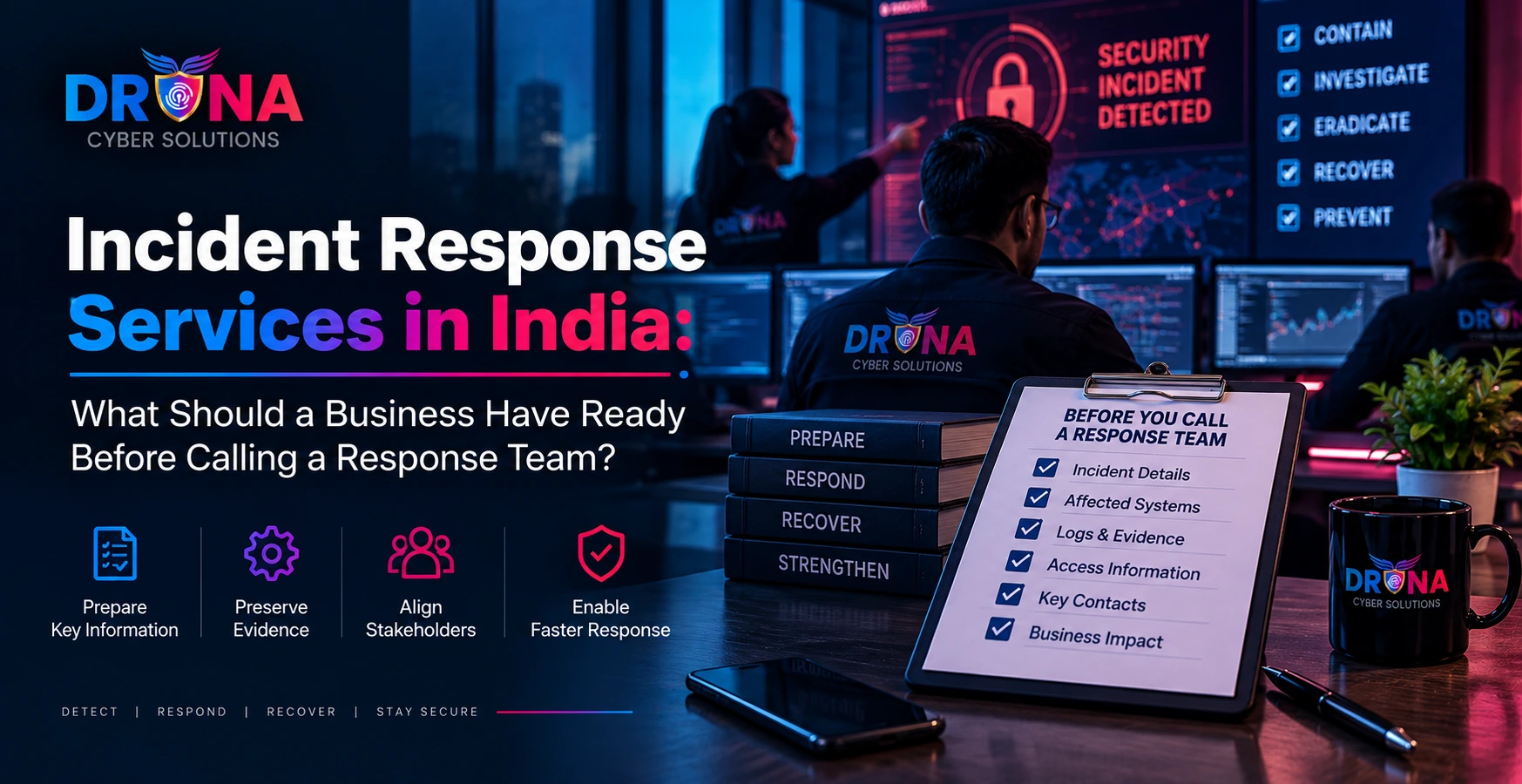
Incident response services in India are critical when a business discovers ransomware, malware, unauthorized access, data theft, or compromised credentials. However, when an incident occurs, the response team should not need time to learn fundamental facts about the organization.
Good incident response readiness means having the right contacts, system information, system logs, system-generated evidence, backups, and escalation processes in place before an emergency.
This readiness gives investigators a stronger starting point and helps the business respond more cohesively.
Why Should Businesses Prepare Before a Cyber Incident?
IT, security, management, legal, compliance, and operations teams can be quickly engaged during a cyber incident. This decision may be needed when systems are out of commission, and the incident’s scope remains unknown.
Businesses therefore need emergency incident response services in India that define who is in charge, which systems are vital, how to maintain an evidence trail, and how to contact the right specialists.
What Should a Business Have Ready Before Calling an Incident Response Team?
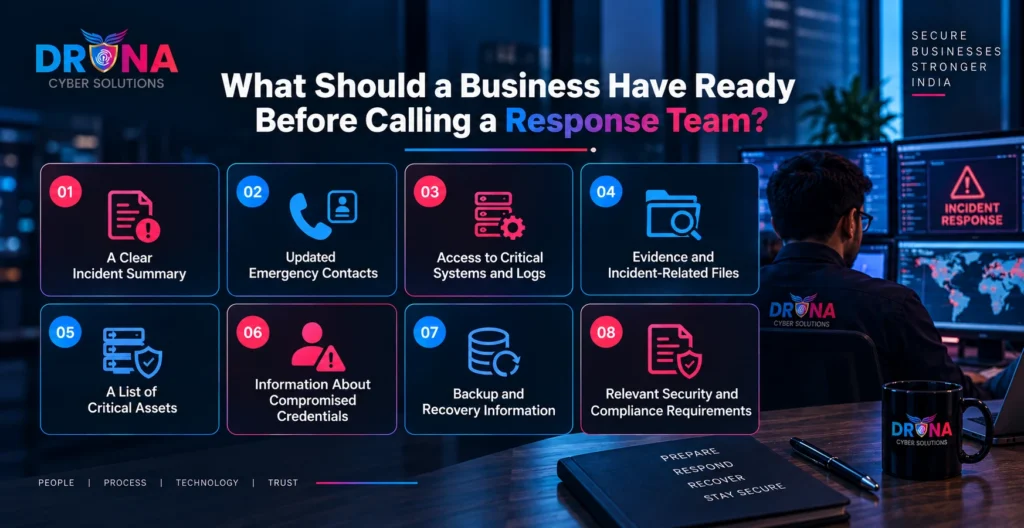
Before choosing incident response services in India, businesses should have key details ready. Below, we have covered crucial details that businesses should have ready before going for incident response services in India
1. A Clear Incident Summary
The response team should know what the business has noticed. At the start, there is no need to write a detailed technical report, but the organization must record when the incident was found, by whom, which systems or accounts are impacted, and what unusual activity is observed.
Useful examples include suspicious emails, links, files, login activity, ransom notes, error messages, and actions already taken. Although the information may change later, the timeline helps the team respond quickly.
2. Updated Emergency Contacts
During a cyber incident, staff will not need to scan through old emails to find the person authorized to make critical decisions.
Maintain a current contact list that includes IT, security, management, legal, compliance, communications, insurance, and external cybersecurity specialists. The organization should also distinguish who has the authority to authorize actions like disabling accounts, isolating systems, or bringing down affected services.
3. Access to Critical Systems and Logs
A response team may need access to endpoint security platforms, identity systems, cloud environments, network infrastructure, applications, and security logs.
Businesses should know where these systems are administered and how to provide emergency access affordably.
Managed SOC Services can also help with this. Ongoing surveillance can detect suspicious behavior and give security personnel a useful warning and context before an incident escalates into a full-fledged investigation.
4. Evidence and Incident-Related Files
Highly visible evidence can be lost quickly during an investigation. Employees without any suspicious knowledge might overwrite or erase suspicious files, reformat corrupt systems, or wipe over compromised systems and devices.
Where feasible, businesses should store pertinent emails, suspicious files, screenshots, alerts, ransom notes, log records, and any other information related to the incidents.
Digital Forensics Services may then help investigate devices, systems, logs, and other evidence to determine how the incident happened and what followed.
5. A List of Critical Assets
The team offering incident response services in India should understand which systems are critical to business functions.
Have a current inventory of strategic nodes, endpoints, databases, clouds, applications, network infrastructure, and other significant assets.
Understanding priorities helps investigators prioritize affected systems and evaluate the impact on the business. It also strengthens broader Cyber Security Services, since organizations cannot defend systems they do not know exist.
6. Information About Compromised Credentials
Credential compromise can cause account takeover, unauthorized access, and further movement across the environment.
Businesses need a process to disable compromised accounts, reset passwords, revoke active sessions, review authentication activity, and check for suspicious logins.
If company credentials or information have been exposed beyond the organization, Dark Web Monitoring Services could provide more insight into the types of exposure.
7. Backup and Recovery Information
Businesses should be aware of where the backups lie, which systems are covered, who will perform the restoration, and have the recovery procedures tested.
This is particularly crucial for ransomware. Reinstating systems prematurely, without understanding the attack, can reintroduce compromised activity.
Ransomware Response Services can assist organizations with encryption, data theft, extortion, containment, and recovery issues. Ransomware negotiation services can also help when attackers demand payment.
8. Relevant Security and Compliance Requirements
Organizations must understand the regulatory, contractual, or internal reporting requirements that may apply to a cyber incident. This information can be prepared and will help the legal, compliance, and security teams coordinate their response.
Compliance audit services can help organizations identify appropriate security requirements and gaps before an incident so they can respond quickly if a security problem is identified during an emergency.
What Should Businesses Know About Their Security Logs?
Security logs may assist investigators to retrace the steps that took place before, during, and after an incident. Authentication logs, endpoint logs, firewall logs, cloud logs, and application logs can also provide useful evidence.
Logs can help determine how an attacker gained access, which accounts were used, which systems were accessed, whether there was lateral movement, and whether there were any suspicious data transfers.
Without adequate logging, even the most reliable incident response services in India have a lower chance of recreating the attack.
Where Does Threat Intelligence Help During an Investigation?
A company can find a suspicious IP address, domain, file indicator, or other technical indicator without knowing whether it relates to a broader attack.
Cyber Threat Intelligence Services can provide more context on malicious infrastructure, threat actors, domains, IP addresses, and other indicators.
This external intelligence can help investigators determine whether suspicious activity links to known threats and whether other systems need investigation.
What Should Businesses Avoid During a Cyber Incident?
Businesses should avoid deleting evidence, wiping affected systems, making unverified public statements, or taking major technical actions without understanding their potential impact.
For example, immediately reinstalling a compromised laptop can remove evidence that may help investigators understand attacker activity.
Containment matters, but where practical, coordinate major actions with the internal security team or external response specialists.
Conclusion
Cyber attacks do not occur at an opportune moment. Having emergency contacts, critical asset details, relevant logs, evidence-management processes, backup data, and escalation processes in place gives the business a much better starting point for response.
Robust incident response preparedness is not merely about having a document. It means combining people, processes, technology, evidence, and specialist support when an incident occurs.
Drona Cyber Solutions is a leading cybersecurity company that integrates incident response services in India with SOC monitoring, digital forensics, malware analysis, threat intelligence, dark web monitoring, ransomware response, and data recovery. This interdisciplinary approach helps companies investigate incidents effectively while strengthening their response capabilities for future cyberattacks.
Contact us today or report an incident, and our team of incident response specialists in India will get in touch with you.
FAQs
What should a business prepare before calling an incident response team?
Businesses should prepare an incident summary, affected-system details, emergency contacts, relevant logs, suspicious files, evidence, backup information, and details of actions already taken.
When should a company call an incident response team?
Consider specialist support when a business suspects a significant cyberattack, ransomware incident, data breach, persistent attacker access, major malware infection, or another incident beyond its internal capabilities.
Can incident response teams investigate ransomware attacks?
Yes. Incident response teams can investigate ransomware activity, support containment, preserve evidence, identify affected systems, and assist with recovery-related activities.
Why is evidence preservation important during a cyber incident?
Preserved evidence can help investigators determine how attackers gained access, what systems they accessed, what actions they performed, and whether additional systems may be affected.
What is incident response readiness?
Incident response readiness is an organization’s ability to identify, escalate, investigate, contain, and recover from a cyber incident using defined people, processes, technology, and information.