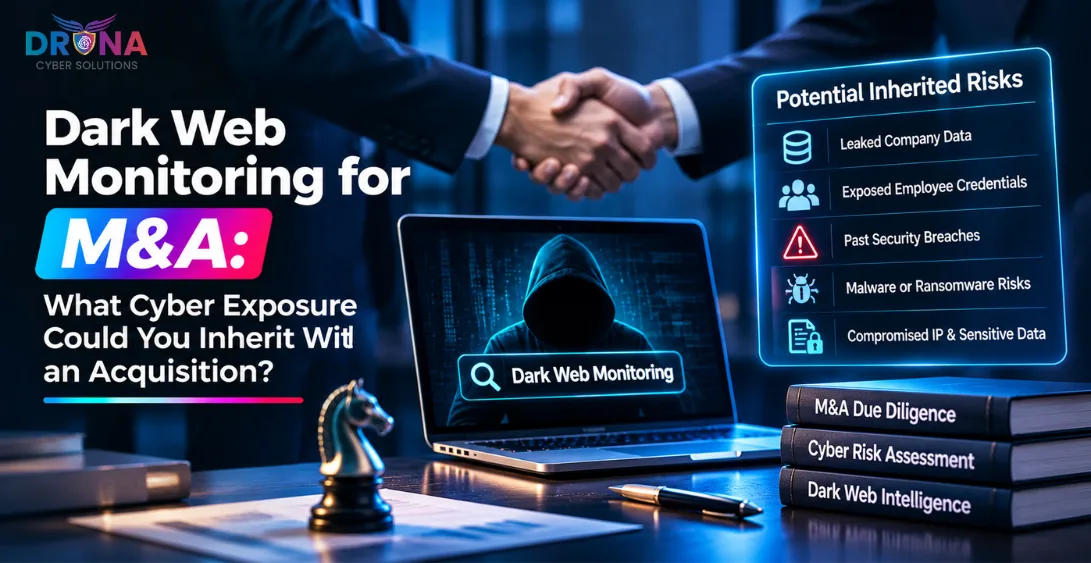
Acquiring a company means taking responsibility for more than its assets, employees, and customers. You may also inherit weak credentials, exposed client databases, vulnerable software, and unaddressed cybersecurity breaches. These risks often aren’t visible in standard financial and legal due diligence.
A dark web risk assessment helps acquiring companies investigate potential digital exposure before completing a transaction. Together with M&A cybersecurity due diligence, it provides a deeper understanding of security vulnerabilities that may influence acquisition costs, integration strategies, and subsequent operations.
Why Should Cybersecurity Be Part of M&A Due Diligence?
Conventional due diligence looks at financial statements, contracts, liabilities and regulatory requirements. Nevertheless, a firm may seem financially healthy but still face a major undisclosed cybersecurity risk.
A successful dark web risk assessment looks for information about the company in criminal markets, breach collections, and other tracked sources.
This evaluation can flag red flags that warrant investigation. It cannot, on its own, establish whether a current breach has occurred in an organisation.
Cyber Security Services support broader technical assessments, while Cybersecurity Compliance Audit Services help assess appropriate security measures and reported compliance failures.
What Cybersecurity Risks Can You Inherit During an Acquisition?

The acquired cyber risk may stem from events that occurred well before the acquisition process began. These exposures remain unresolved because the target organisation lacks sufficient visibility or investigative capacity.
The risks below are of particular interest.
1. Compromised Employee Credentials
Past breach data or malware logs may contain corporate email addresses and passwords. A dark web risk assessment can detect exposed credentials for the target. Nevertheless, investigators need to check whether those credentials are still effective.
Cyber Threat Intelligence Services may provide additional information on suspicious credential exposure and threats.
2. Exposed Customer and Financial Information
Leaked customer records, contracts, financial documents, or internal communications can pose privacy, contractual, and reputational issues.
Dark Web Monitoring Services may help identify potentially disclosed data that needs confirmation. Acquirers must decide whether the exposure was investigated by the target and whether the target met any relevant notification requirements.
3. Unresolved Ransomware Incidents
A target company might have been the victim of ransomware, restored its systems, and then continued operations without thoroughly examining what happened. A dark web risk analysis can pinpoint mentions of the company on ransomware-related leak sites.
Ransomware Response Services and Digital Forensics Services can support further investigation when credible indicators suggest an unresolved compromise.
4. Compromised Vendors and Third-Party Access
The target of acquisition may use outside IT suppliers, cloud computing services, or contractors with access to sensitive systems.
Disclosed vendor credentials or broken integrations may pose post-ownership risks. Cyber Security Consulting Services can support third-party access assessments, security responsibilities, and integration-related weaknesses.
How Does Dark Web Monitoring Support Acquisition Decisions?
Dark web risk assessment offers external exposure intelligence to internal security assessments. It can help buyers ask more informed questions before accepting the seller’s cybersecurity representations.
Identify Historical Exposure
Investigators search through the available records of breaches, leaked credentials, and references to the target organisation.
Consider historical results, since old or repeated records may not reflect the current compromise.
Validate Potentially Sensitive Information
Not all advertised data sets are legitimate. Investigators need to determine whether the identified information is owned by the target and whether it poses a significant risk.
Digital Forensics Investigations can validate evidence when suspicious records require technical analysis.
Evaluate Threat Actor Activity
Mentions of a company during criminal conversations can be signs of targeting, attempted exploitation, or false claims.
Dark web risk management must distinguish between credible evidence and unconfirmed allegations.
Support Acquisition Risk Planning
Proven outputs can be employed to establish budgets for cleanup, contractual controls, closing conditions, and post-acquisition security priorities.
Incident Response Services can apply if due diligence reveals signs of a current security incident.
When Should Buyers Conduct a Dark Web Risk Assessment?
Timing matters because cybersecurity findings may influence transaction decisions. A dark web risk assessment is most effective during pre-acquisition due diligence, before the buyer has finalised its risk acceptance and integration strategy.
The evaluation should also be revisited if significant new information emerges before closing. After acquisition, further monitoring can detect new exposure in newly integrated systems, employees, and digital assets.
Managed SOC Services can support ongoing threat detection, while Malware Analysis Services may assist when suspicious software or infection indicators require investigation.
What Should an M&A Cybersecurity Due Diligence Checklist Include?
Both external exposure and internal security practice of the target company should be thoroughly reviewed.
Important areas include:
- Past events, unpatched weaknesses and exposed credentials.
- Sensitive data storage, access controls, and third-party integrations.
- Evidence retention, incident reporting, and security monitoring.
- Backup checks, recovery testing and integration readiness.
Vulnerability testing, policy testing, and technical testing should supplement, not replace, a dark web risk assessment.
When information is unavailable due to past incidents, Data Recovery Services can help assess recovery obstacles.
For similar advice, read Cybersecurity Compliance Audit: 10 Controls Indian Companies Should Test Before an External Audit and Failed a Security Audit? What to Fix Before Your Next Compliance Review.
Can Dark Web Findings Affect Acquisition Valuation?
Yes, credible cybersecurity findings can affect transactional conversations, but the financial implications vary by situation.
A dark web risk assessment can identify exposure that requires additional research, remediation costs, or changes to integration plans.
Buyers can consider contractual indemnities or warranties, remediation requirements, or amended transaction terms.
Nevertheless, a disclosed credential or history of breaches may not necessarily warrant a decrease in a company’s value. Confirm and test results against real business risks.
Conclusion
Are you buying a profitable business or inheriting compromised accounts, customer data, and unresolved cyberattack cases? How do you handle a breach discovered post-closing, sensitive data posted on a criminal board, or an employee with privileged credentials creating a vulnerability in your new-fangled systems?
These challenges can raise remediation costs, delay integration, expose confidential data, and create conflicts over responsibilities.
Drona Cyber Solutions helps acquiring companies identify potential cybersecurity exposure before it becomes a post-acquisition issue. Drona helps organisations uncover suspicious exposure through its dark web monitoring services, backed by threat intelligence, digital forensics, and incident response services to assess credible threats and prioritise further investigation.
Don’t inherit cyber risks after you sign the deal. Ask Drona Cyber Solutions to evaluate your acquisition target’s digital footprint, assess breach risks, and help you decide with greater confidence.
FAQs
What is a dark web risk assessment in M&A?
A dark web risk assessment identifies potential exposure for an acquisition target, such as leaked credentials, sensitive records, and references in monitored criminal sources.
Will dark web monitoring detect all past cyberattacks?
No. Surveillance cannot identify all breaches, and the absence of tracked activity does not prove an organisation has never been attacked.
Should cybersecurity evaluations be carried on post-acquisition?
Yes. Post-acquisition monitoring helps detect new threats and supports security management, as systems, users, and third-party relationships are interwoven.