In 2026, a breach will not look the same as it did ten years ago. No single one can be isolated. No obvious device to seize. No pathway trim with a hard drive. In the modern day, attacks traverse cloud workloads, SaaS, APIs, containers, and identities. The traces are dispersed across geographical locations, overlap within seconds, and are buried within enormous log streams.
That is why the investigations have become reliant on Cloud Forensics Services.
Companies are discovering the fact that security is not all. If something is wrong, they should know what occurred, how it occurred, which data is affected, and whether it can be repeated.
Lack of forensic visibility leaves the companies in a guessing game, and no one would risk guessing when the regulators, customers, and business continuity are at stake. By 2026, Cloud Forensics Services will have become the foundation of breach investigation and will help businesses swiftly, precisely, and with defendable proof rebuild incidents.
What Are Cloud Forensics Services?
Cloud Forensics Services, simply put, is a specialized operation for collecting, storing, examining, and reporting on digital evidence from cloud environments at the time of, or after, a cyber incident.
These services focus on:
- Inquiry into unauthorized access.
- Recreating the activity of attackers.
- Saving evidence to be used to comply with the law.
- Determining the extent of data exposure.
- Recovery and incident response Support.
Cloud Forensics Services are also fast to deploy in a live system, unlike traditional ones, which can disrupt business operations.
Nature of Data Breaches Has Changed
In 2026, data breaches are no longer considered low-level technical accidents. They are massive, identity-based, cloud-native occurrences that occur across a variety of systems simultaneously. Cloud infrastructure has drastically altered the intensity and the form of cyberattacks.
Here’s what the current threat landscape looks like:
- Over 85% of organizations now operate in multi-cloud environments, increasing the complexity of investigations.
- Nearly 60% of reported breaches involve cloud-hosted assets rather than on-premise systems.
- Misconfiguration remains a leading cause, contributing to 1 in 3 cloud-related data exposures.
- The average organization uses more than 120 SaaS applications, creating hundreds of potential evidence sources.
- Investigators must analyze data spread across 3 to 5 geographic regions on average during a single breach case.
- Stolen credentials are now involved in over 70% of successful cloud intrusions, replacing traditional malware-led attacks.
- Nearly 80% of digital evidence in cloud incidents is volatile, meaning it can disappear quickly if not preserved immediately.
Why Traditional Investigation Methods Fail in Cloud Environments
In a traditional IT infrastructure, investigators could copy disks and examine them offline. But the cloud is dynamic. Data moves. Logs rotate. Containers disappear. Sessions expire.
In the absence of dedicated Cloud Forensics Services, important evidence can be lost before the investigators even start. The conventional approaches are problematic as:
- There is a distribution of evidence in various geographical areas.
- Cloud vendors handle infrastructure layers.
- It is identity-based and not device-based.
- There are transient workloads of data.
- Cloud log volumes cannot be analyzed manually.
This transformation has rendered Cloud Forensics Services a necessity for every organization operating digitally by 2026.
Role of Cloud Forensics Services in Data Breach Investigation
Let us look at the way these services work in a breach.
1. Immediate Evidence Preservation
The initial consideration when handling an attack is conservation of volatile data.
Logs and temporary workloads in cloud environments are constantly overwritten. Without securing evidence immediately, it can be lost permanently. Cloud Forensics Services intercept:
- Access logs
- Metadata
- System snapshots
- Network activity trails
- User session records
This is to ensure that the investigation commences on sound evidence. At Drona Cyber Solutions, we also offer best Digital Forensic Services that help you away from cyberattacks.
2. Identifying the Entry Point
Among the most significant measures in a breach investigation is learning how attackers gained access. Investigators analyze using Cloud Forensics Services:
- Identity and Access Management activity.
- Authentication errors and abnormalities.
- API call histories
- Privilege escalation incidents.
This helps determine the cause of the breach, whether it’s phishing, credential theft, or configuration weaknesses.
3. Reconstructing the Attack Timeline
Knowing when and how things occurred is essential in decision-making and reporting.
Cloud Forensics Services integrate various sources of information into developing a clear chain:
- Initial compromise
- Movement across systems
- Data access patterns
- Exfiltration attempts
- Persistence mechanisms
The timeline is clear to internal teams and regulatory authorities.
4. Determining What Data Was Affected
The question that organizations have to respond to following a breach is a tough one: What exactly was exposed?
Cloud Forensics Services are used to assess the storage access, download patterns and query logs to identify:
- Which files were accessed
- Data was either copied or altered.
- The duration of the attackers’ access.
- The presence or absence of sensitive records.
This wisdom is critical under legal disclosure mandates in 2026.
5. Supporting Regulatory Compliance and Reporting
Timely disclosure of a breach is now mandatory by global and regional regulations. Organizations face penalties if forensic clarity is lacking. The Cloud Forensics Services produce structured reports that are useful in assisting businesses to:
- Abide by data protection requirements.
- Show investigative diligence.
- Give breach notification based on evidence.
- Legal procedures and support audits.
In 2026, compliance cannot be separated from forensic capability.
6. Detecting Insider Threats
Not every violation is external. A large number of them are initiated internally due to unauthorized entry. Cloud Forensics Services examine the patterns of behavior and detect:
- Unauthorized data downloads
- Access outside normal working patterns
- Privilege misuse
- Suspicious administrative actions
This makes them important in detecting internal risk.
7. Enabling Faster Incident Response
There is now a relationship between investigation and response. The sooner organizations are aware of an incident, the sooner it can be contained. The Cloud Forensics Services are fast at response because they offer:
- Real-time visibility into attacker actions
- Actionable intelligence for containment
- Insights to close exploited gaps
- Evidence-based recovery strategies
Speed minimizes financial losses and reputational damage.
Key Benefits of Cloud Forensics Services in 2026
Companies that invest in forensic preparedness benefit a lot. Cloud Forensics Services are beneficial because they assist businesses:
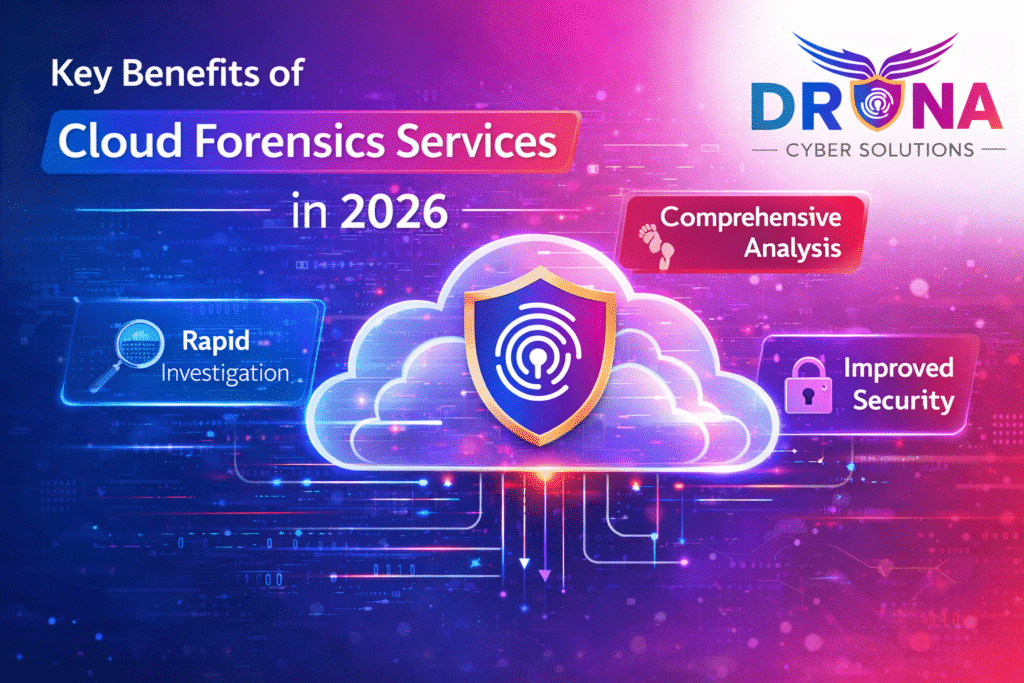
- Investigate breaches without shutting down systems
- Maintain operational continuity during analysis
- Strengthen long-term security posture
- Improve transparency with stakeholders
- Reduce legal and regulatory exposure
Speed of investigation is business resilience in a cloud-first world.
Industries Relying Most on Cloud Forensics Services
Digital transformation has put entire industries on a cloud-first infrastructure. That change has enhanced speed and scalability and has complicated investigations significantly when incidents do take place.
Cloud Forensics Services are no longer reactive tools for industries that handle sensitive information, large transaction volumes, or regulated information. They are operational protection. We will examine the domains of cloud forensic capability that are currently mission-critical.
- Financial services handling transactional data
- Healthcare organizations storing patient records
- SaaS providers managing multi-tenant environments
- Government agencies operating digital infrastructure
- E-commerce platforms processing high-volume transactions
Such industries cannot afford to lose money due to a breach. They need Cloud Forensics Services to provide transparent, quick responses.
Growing Importance of Forensic Readiness
Organizations are shifting to proactive forensic preparedness in 2026, no longer just responding to incidents. This includes:
- Continuous log retention strategies
- Secure evidence collection frameworks
- Regular forensic simulations
- Integration with incident response planning
When integrated into the cybersecurity strategy, Cloud Forensics Services enable businesses to be proactive in preventing incidents rather than rushing to put the situation back on track once it has occurred.
Challenges Addressed by Cloud Forensics Services
Modern cloud investigations face unique obstacles:
- Lack of physical control over infrastructure
- Encrypted environments are complicating analysis
- Shared responsibility between provider and customer
- Massive data volumes requiring automation
- Jurisdictional complexities across regions
Cloud Forensics Services are designed to address these challenges without compromising the integrity of evidence.
How Cloud Forensics Services Strengthen Long-Term Security?
A forensic investigation has greater value than resolving a single incident. It assists in enhancing organizations. The lessons learned using Cloud Forensics Services facilitate:
- Better access control policies
- Improved monitoring configurations
- Reduced misconfigurations
- Stronger data governance practices
- Enhanced risk management frameworks
Every investigation is an educational process that builds defenses.
Drona Cyber Solutions provides advanced cybersecurity solutions to help businesses protect their digital systems and sensitive data from modern cyber threats. Using AI-driven threat intelligence, real-time monitoring, and expert incident response, the company helps organizations detect risks early, prevent attacks, and recover quickly from security breaches.
Future of Data Breach Investigation
There is a new phase of data breach investigations. They are no longer reactive exercises performed once damage has occurred. The future is characterized by rapidity, automation, and intelligence-led analysis that commences the instant suspicious activity is exhibited.
As organizations continue to transform into distributed cloud ecosystems, investigations must be conducted at the same scale and speed. It is here that Cloud Forensics Services are transforming from post-incident tools into a continuous investigative framework within cybersecurity operations.
From Reactive Investigations to Continuous Visibility
Earlier, investigations were initiated upon receiving alerts. Attackers were by this time usually days or weeks into the system. The next-generation model incorporates Cloud Forensics Services in the monitoring environments, which enables the organizations to:
- Capture forensic data in real time
- Preserve evidence automatically before it disappears
- Detect patterns that indicate early-stage compromise
- Investigate incidents while they are still unfolding
This transition drastically reduces breach dwell time and constrains business impact.
AI and Automation Will Drive Investigation Speed
The amount of data generated daily in the cloud is already too much for human reviewers to manually review. Future research will rely on artificial intelligence, which can process millions of log entries, correlate anomalies, and present meaningful evidence in real time. Through Cloud Forensics Services aided by AI, investigators are able to:
- Reconstruct complex attack paths within minutes
- Identify behavioral anomalies across multiple platforms
- Reduce false positives through contextual analysis
- Prioritize high-risk incidents for immediate action
Evidence Collection Will Become More Dynamic
Cloud computing will generate transient data and may disappear quickly. Future forensic approaches aim to automatically capture volatile evidence without disrupting workloads.
Modern Cloud Forensics Services is moving towards:
- Continuous snapshotting of critical workloads
- Automated chain-of-custody documentation
- Secure evidence storage aligned with compliance needs
- Real-time synchronization across multi-cloud environments
As a Leading Cloud Forensic Company in Ahmedabad, we offer exclusive cybersecurity services to keep your business protected from cyber threats.
Investigation Will Be Closely Tied to Compliance and Governance
Global regulations are tightening the noose on transparency and accountability for breaches. The studies to be conducted in the future will not only show what occurred but also demonstrate that the organizations acted correctly.
With developed Cloud Forensics Services, companies will be capable of:
- Produce audit-ready forensic reports quickly
- Align incident investigations with regulatory frameworks
- Maintain clear documentation for legal and compliance reviews
- Strengthen trust with customers and stakeholders
The concept of forensic preparedness will be regarded as a governmental effort, not just a cybersecurity one.
Collaboration Between Security, Legal, and Operations Teams Will Increase
Breach investigation has a cross-functional future. Security teams, legal advisors, compliance officers, and IT operations should collaborate to share forensic knowledge.
Cloud Forensics Services platforms enable such teams to:
- Access unified investigation dashboards
- Coordinate response strategies efficiently
- Share validated evidence without duplication
- Reduce operational disruption during incidents
Conclusion
Data breaches will be intricate, rapid, and deeply embedded in cloud infrastructure in 2026. Organizations are no longer able to apply the old methods of investigation developed in a static setting.
Cloud Forensics Services provide visibility, speed, and accuracy in understanding what actually occurred during a breach. Drona Cyber Solutions is the best Cloud Forensics company, with a team of cybersecurity leaders, experts, and defenders who help preserve evidence, ensure compliance, and support recovery, keeping the business operational.
In a digital-first economy, prevention is no less significant than incident response. Firms investing in Cloud Forensics Services receive not only the ability to investigate but also confidence, accountability, and the ability to survive in a changing threat landscape.
The breach investigation is already in the future and is cloud-based.