
Is your business prepared to explain how it collects, stores, protects, and deletes customer information? From 13 May 2027, major provisions of India’s Digital Personal Data Protection Act, 2023, and the DPDP Rules, 2025, will become enforceable.
The DPDP Compliance Deadline 2027 is particularly important for organizations that process digital personal data. Businesses must review their privacy notices, consent practices, security safeguards, and breach response procedures before the applicable requirements take effect.
Preparing now through Data Protection Compliance Services can help organisations identify operational gaps before enforcement begins.
What Is the DPDP Compliance Deadline 2027?
India’s Digital Personal Data Protection Act, 2023, establishes requirements for processing digital personal data. The government notified the DPDP Rules, 2025, on 13 November 2025, introducing phased implementation.
The DPDP Compliance Deadline 2027 refers to 13 May 2027, when major obligations concerning lawful processing, consent, security safeguards, breach notification, and individual rights are scheduled to commence.
The implementation follows three phases:
- 13 November 2025: Initial statutory provisions and Data Protection Board framework.
- 13 November 2026: Consent Manager registration provisions.
- 13 May 2027: Major operational compliance obligations.
Businesses should review their responsibilities through Cyber Security Consulting Services rather than assume every provision applies identically to every organisation.
Which Businesses Must Comply With the DPDP Act?
The Act generally covers digital personal data collected in digital form or subsequently digitised. It can also apply to processing outside India when connected with offering goods or services to individuals in India.
Companies processing customer, employee, patient, or user information may fall within its scope, subject to statutory exemptions.
The DPDP Compliance Deadline 2027 therefore matters to businesses across ecommerce, healthcare, finance, technology, and other sectors.
Compliance Audit Services can help organisations evaluate their existing controls against applicable requirements.
What Data Protection Requirements Must Businesses Prepare For?
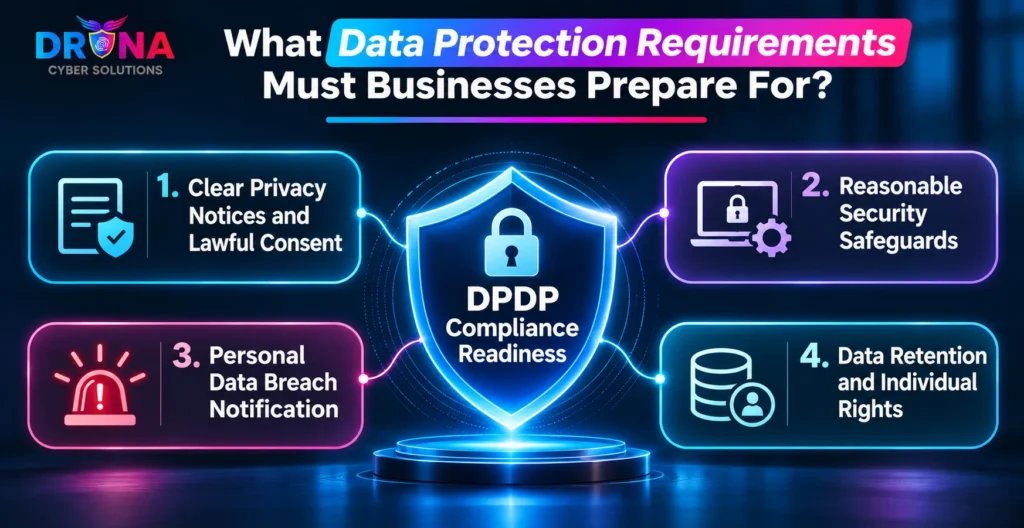
The DPDP framework establishes several responsibilities for organisations acting as Data Fiduciaries.
Preparing for the DPDP Compliance Deadline 2027 requires translating these obligations into documented processes and technical controls.
1. Clear Privacy Notices and Lawful Consent
Organisations must provide notices explaining the personal data involved, processing purposes, and available rights.
Where consent is the applicable legal basis, it must satisfy statutory requirements. The Act also permits certain specified legitimate uses.
Data Privacy Compliance Services can support assessments of notices, consent workflows, and processing practices.
2. Reasonable Security Safeguards
Data Fiduciaries must implement reasonable security safeguards to prevent personal data breaches.
Rule 6 specifies measures including encryption, access controls, monitoring, backups, and appropriate contractual safeguards.
VAPT and Red Teaming Services can help identify technical weaknesses that require remediation.
3. Personal Data Breach Notification
Under Rule 7, affected individuals must receive prescribed information without delay after the Data Fiduciary becomes aware of a personal data breach.
The Data Protection Board must also be informed without delay, followed by specified detailed information within 72 hours, unless an extension is allowed.
Incident Response Services can support breach investigation and coordinated reporting preparation.
4. Data Retention and Individual Rights
Businesses must establish procedures for applicable access, correction, erasure, and grievance-related requests.
Personal data must be erased when required under the Act, subject to applicable retention obligations and exemptions.
Digital Forensics Services may support investigations involving disputed data access or suspected information exposure.
What Cybersecurity Controls Should Companies Review Before May 2027?
The DPDP Compliance Deadline 2027 makes cybersecurity preparedness an important compliance priority. Organisations should assess whether existing safeguards adequately protect the personal data they process.
1. Access Management and Authentication
Review privileged accounts, employee permissions, authentication methods, and access termination procedures.
Managed SOC Services can support monitoring for suspicious account activity.
2. Vulnerability Management
Identify unpatched software, insecure applications, exposed databases, and configuration weaknesses.
Vulnerability Assessment Services can support prioritisation of identified security gaps.
3. Security Monitoring and Incident Detection
Establish procedures for identifying unusual access, suspicious transfers, and potential breaches.
Cyber Threat Intelligence Services can provide additional context about relevant external threats.
4. Third-Party Data Protection
Review contracts and safeguards involving vendors that process personal data on the organisation’s behalf.
Cyber Security Risk Assessment Services can support evaluation of vendor-related security exposure.
What Penalties Can Businesses Face Under the DPDP Act?
The DPDP Compliance Deadline 2027 also introduces significant financial consequences for certain violations.
The Act provides for penalties of up to ₹250 crore for failure to take reasonable security safeguards to prevent personal data breaches.
Other specified violations carry different maximum penalties. These amounts are statutory ceilings, not automatic fines for every incident.
The Data Protection Board determines penalties after considering relevant statutory factors.
Cybersecurity Compliance Remediation can help businesses prioritise identified security weaknesses before enforcement.
How Can Businesses Prepare Before the Deadline?
Businesses should begin with a structured DPDP Act compliance checklist covering personal data inventories, processing purposes, consent, security controls, retention practices, and incident response.
Before the DPDP Compliance Deadline 2027, organisations should:
- Identify personal data collected and processed.
- Review notices and applicable consent mechanisms.
- Assess security safeguards and vendor arrangements.
- Establish breach notification procedures.
- Document responsibilities and corrective actions.
Cyber Security Audit Services can support technical readiness assessments, although an audit alone does not establish legal compliance.
Conclusion
What happens if your organisation discovers a customer data breach but cannot identify affected records? Can your team investigate the incident, notify the appropriate parties, and demonstrate reasonable safeguards? What if an assessment reveals exposed databases, excessive employee access, or inadequate security monitoring?
These weaknesses can create serious challenges once the DPDP Compliance Deadline 2027 arrives.
Drona Cyber Solutions helps Indian businesses identify and address cybersecurity weaknesses through Compliance Audit Services, VAPT, Managed SOC, Digital Forensics, and Incident Response capabilities.
With the DPDP Compliance Deadline 2027 approaching, organisations should assess their security posture, document critical gaps, and prioritize corrective measures.
Don’t wait until a personal data breach exposes your compliance weaknesses. Contact Drona Cyber Solutions today to schedule a cybersecurity compliance assessment and strengthen your organisation’s readiness before 13 May 2027.